

Learning First Science
What’s Included
Teacher Guide, Student Workbook, Stories and Experiments
Teacher Guide
Everything you need to teach science with confidence, including lesson plans and activities, assessment tasks, answer keys, built-in ways to address student misconceptions and much more.
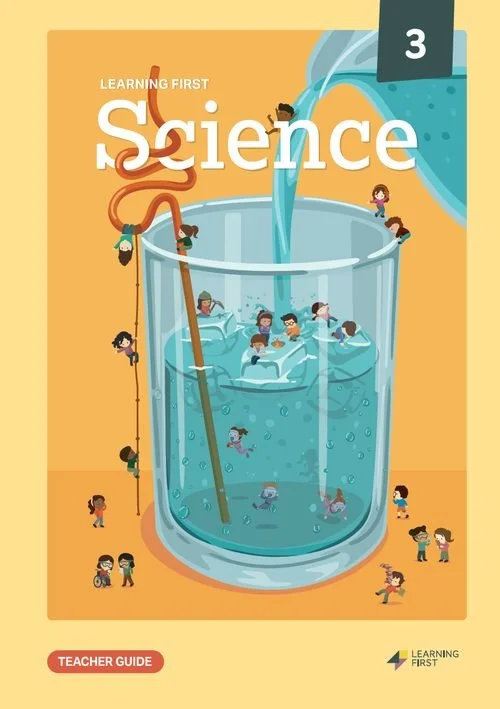
The Teacher Guide is the year in one book: 40 detailed lessons across four units, part of a complete seven-year sequence from Foundation to Year 6. One book to teach from.
Every unit opens with what you need before the first lesson:
A summary of the unit — what students think now, what they will learn, and where it sits in the seven-year sequence
Science background knowledge for teachers, busting the misconceptions students may hold, and preparing teachers for expert science teaching
The knowledge and skills of the unit, with objectives in both teacher and student language
Pedagogical guidance, and the classroom routines that make explicit instruction routine
Retrieval practice question sets and guidance to improve retention, focused on the most important concepts in each unit
Morphology and vocabulary support, including links to the unit's ten science stories, a glossary, and links to learning in other subjects
Curriculum links for all Australian curriculums, including the Australian Curriculum, NSW syllabuses, and the Victorian and Western Australian curriculums. Other curriculum links can be developed as required.
Each unit contains ten 60-minute lessons, each moving through the same five stages - Review, Explain, Catch, Practice, Close. Every lesson gives you expert-crafted explanations for the genuinely hard concepts, clear and precise language for every key idea and new term, answer keys for every question you ask, teacher notes that anticipate the tricky questions and explain the simplifications, and a decision point: move on, or reteach.
Learning First Science aligns with and improves on every Australian curriculum. We took what is taught in the best classrooms in the world and brought it home, because Australian students deserve the best in science curriculum and instruction.
Every lesson is built on the science of learning and explicit instruction. Highly interactive, participative teaching gives students structured and frequent opportunities to respond and practise, so they build rich schemas of knowledge rather than memories of an activity. There is enough detail to teach with confidence, and never a rigid script. This was never built to replace the teacher in the room - it was built to make great teachers unstoppable.
“When I pick it up and read it, I can see the lesson I need to teach.”
— Teacher
“Lessons were really detailed - so really helpful for me as I didn't feel confident teaching science.”
— Teacher
Student Workbook
A complete package for your students to dive into investigations, run experiments, demonstrate their learning, with built-in assessment tasks.

In the Student Workbook you will find the activities, investigations and experiments students complete in each lesson, and the questions that make them think hard about what they have just seen.
Every task is designed to focus student attention on the key features of the concept being taught. Hands-on and practical - but in service of rich, interconnected schemas of knowledge, tied to experiences and observations students can point back to years later. Students build disciplinary knowledge of how scientists find out about the world around them. Predicting, fair testing, observing, measuring, recording, concluding, learned in context with real practice.
Three kinds of task, chosen to fit the science:
Activities - focused practice for students to use new knowledge and vocabulary, and rehearse scientific explanations
Investigations - students observe, measure and record, then explain what they saw
Experiments - a fair test, set out the way scientists set it out: aim, prediction or hypothesis, method, results, conclusion
This is not scientist roleplay. Each activity is a deliberate, explicit, practical demonstration of the principle students are learning about. It was chosen because it teaches that principle, it lets students rehearse their new knowledge, and it is checked in the same lesson to confirm the learning is secure. And it can all be done with cheap, easily available equipment from supermarkets and common retailers - no lab, no specialist kit.
Around every task sit expertly crafted questions that direct student attention to the knowledge itself, and to how it connects with what they already know. Every lesson carries a Science Star: an extension question that asks students to apply their new knowledge flexibly, in an unfamiliar situation. Every unit includes a summative assessment task, so teachers can track what students have actually learned.
“Very engaging and great timing to play, experiment and learn all while having fun!”
— Teacher
“That was the best lesson I've ever had.”
— Student
Stories & Experiments
Engaging texts matched to every topic, spanning a range of genres to build literacy skills alongside science understanding. Includes text questions & morphology.

Stories and Experiments includes 40 stories directly linked to the four units taught in the year, plus activities designed for families - no specialist knowledge, no expensive equipment, no complicated experiments.
The books connect directly to the knowledge and concepts taught in the units. By encountering the same ideas again in a different setting, students get another opportunity to recall important knowledge, use scientific vocabulary, and make connections between classroom learning and their everyday experiences.
Science Stories are directly linked to the four units taught in the year. There is a mixture of fiction and non-fiction, and a wide variety of text types - explanations, biographies, comics, procedures, news articles and opinion pieces. Accompanying the stories are questions for the teacher to use to guide discussion and connect the text to the science, along with the morphology of specific scientific vocabulary for use in lessons on language conventions.
Across the years, Science Stories help students to:
Build broad substantive knowledge in science
See how scientific ideas apply beyond the classroom
Encounter key vocabulary repeatedly, in meaningful contexts
Make connections between concepts taught across a unit
Develop listening, speaking and reading comprehension
Build curiosity and wonder about the world
Strengthen long-term understanding by revisiting knowledge through memorable examples
The stories are a bridge between science and literacy. Students hear and discuss rich informational texts, encounter scientific vocabulary, and practise listening, speaking and comprehension while continuing to build their science knowledge. Because the ideas are embedded in memorable people, places, animals, events and problems, the stories also make abstract concepts more concrete and easier to remember.
Science Stories do not replace explicit teaching or practical science. They add a complementary layer. Students learn the concept directly, observe or investigate it where appropriate, then encounter that knowledge again through a rich and engaging story - multiple ways to understand, connect and remember.
The experiments encourage students to notice science in the world around them - in their home, backyard, local parks and everyday routines. Science is not something that only happens in a science lesson or a laboratory. It is a way of understanding the world they experience every day.
Through Science experiments, students can:
Revisit and consolidate important scientific knowledge
Practise using scientific vocabulary
Connect classroom learning to everyday experiences
Explain their scientific thinking to others
Involve families in their science learning
Strengthen understanding through repeated retrieval in a different context
Explaining an idea, answering a question or completing an activity together requires students to retrieve and use what they have learned - which is what strengthens understanding and long-term retention.
School leaders regularly tell us how hard it is to communicate the curriculum to parents. This book solves that problem in a very tangible way: families can see exactly what their child is learning, and join in.
“The kids are loving the science stories, and vocabulary and understanding is going through the roof.”
— Teacher