

LEARNING FIRST SCIENCE CURRICULUM
A world-class primary science curriculum that lifts the bar on learning, engagement and joy.
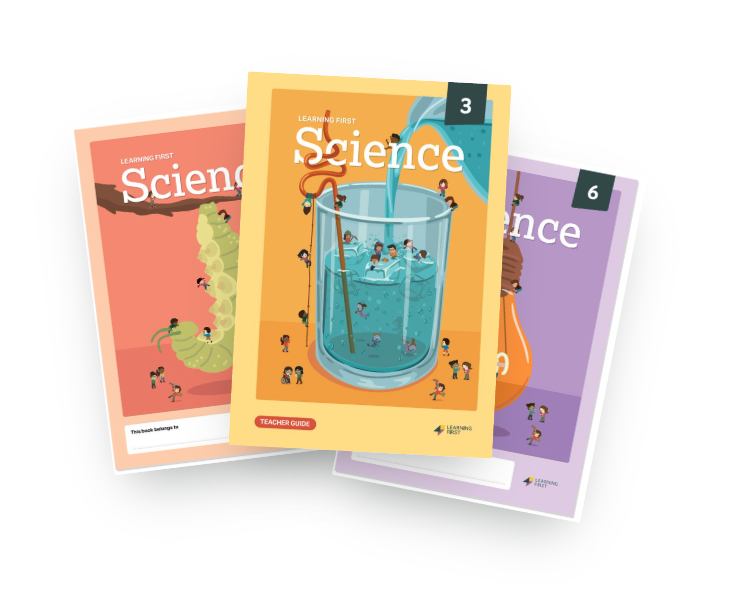
A complete, seven-year sequence from Foundation to Year 6 - built from what the world's highest-performing school systems teach, and designed for teachers to deliver with confidence.
WHAT’S INCLUDED
Three complementary parts
Teacher Guide
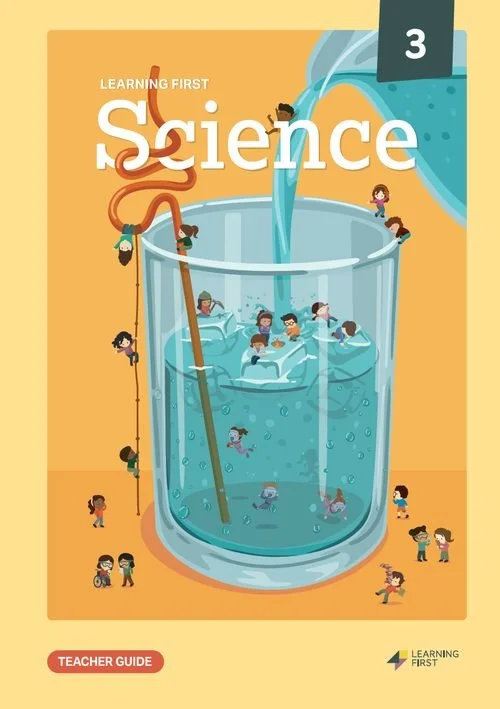
Everything you need to teach science with confidence, including lesson plans and activities, assessment tasks, answer keys, built-in ways to address student misconceptions and much more.
Student Workbook
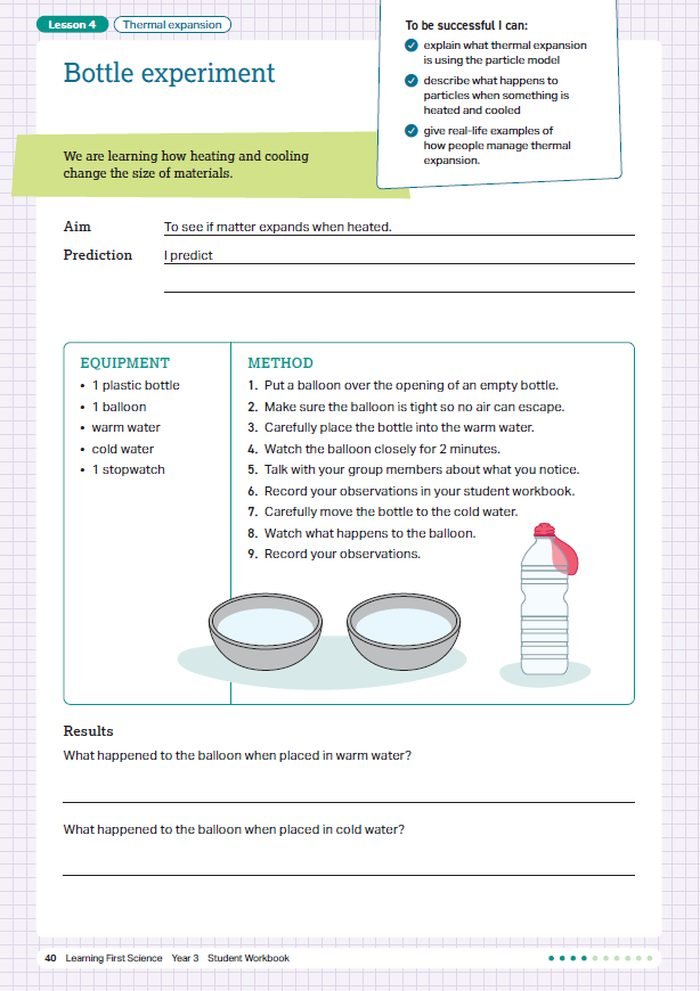
A complete package for your students to dive into investigations, run experiments, demonstrate their learning, with built-in assessment tasks.
Stories & Experiments
Science stories and experiments for curious minds, based on world-class primary science curriculum.

SETTING THE BAR
Benchmarked against the world’s best
Learning First has conducted the most detailed curriculum benchmarking ever completed, comparing science curriculums in leading countries such as Singapore, Hong Kong, Japan, England, and in top-performing provinces such as Alberta, Canada.
Learning First Science is built on that research. Students come out with equivalent levels of science to that provided by curriculums in the highest-performing systems around the world.
INSIDE A LESSON
A consistent, explicit lesson structure
Every lesson moves through five stages, so instruction is clear, active and checked for understanding - delivered without slides, teachers facing their students, not a screen.
1
Review
5-10mins
Activate relevant prior knowledge
2
Explain
15-25mins
Clear, sequenced teacher scripts introduce new content
3
Catch
5mins
A whole-class check before moving on
4
Practice
20-35mins
Hands-on application with thinking prompts
Learn more about how our instructional approach can be adapted to your school
5
Close
5-10mins
Consolidates key knowledge and skills
THE FULL SEQUENCE
Seven years, mapped out in full
Every strand and topic from Foundation to Year 6, sequenced so knowledge builds year on year instead of being re-taught from scratch. Resources are provided to show how schools can report against each curriculum in Australia and in other countries.
A WORLD TO DISCOVER
Builds joy and wonder in the diversity of life on earth
Learning First Science provides the depth and breadth of a world-class curriculum and takes students into a wide range of geographies, ecosystems and the wonderful diversity of life on earth. In doing so, students gain a broader understanding and appreciation of the science, but also build connections to learning geography and other subjects.

Hot deserts in the Sahara

Marine ecosystems

Tropical rainforests in Borneo

Wetlands in Kakadu

Temperate forests of Yosemite

Cold climate Antarctica

Fungi

Plants

Vertebrate animals

Invertebrate animals

Algae

Micro-organisms
REAL FEEDBACK, REAL RESULTS
What teachers and students are saying
“So excited by the solar system unit. The lesson on Jupiter blew their minds.”
— Teacher
“Science is now one of the most enjoyable experiences for our kids in class”
— Teacher
“We have students talking about science at recess and lunch … we've never had that before.”
— Teacher
WHY WE FOCUS ON READING AND WRITING
Teaching students to read and write like scientists
Science speaks its own language — precise, technical, and nothing like the way students naturally talk.
Learning First Science teaches that language explicitly, building the vocabulary and sentence patterns students need to describe, explain and argue like a scientist. The payoff reaches well beyond science: strong background knowledge is what drives reading comprehension from upper primary onward, so as students build scientific knowledge, they build the comprehension that carries into every other subject.
“The cute little ant was tiptoeing under the leaves and staying safe”
becomes…

“I observed an ant with a small body, which may help it to survive in the leaf litter because it can crawl under leaves to hide from predators.”

ADAPTED TO YOUR NEEDS
Adaptable Delivery, Uncompromised Sequence
Adapt the year-level sequence
An alternative two-year cycle lets composite classes cover the full range of content across year bands.
Adapt the number of lessons
Each unit flags lessons that are least disruptive to omit, keeping the knowledge sequence intact.
Adapt the lesson length
Split lesson phases across two sessions or swap an investigation for a teacher demonstration.
SAMPLE UNITS
See exactly what your students would get
A free sample from our Year 3 Chemical Sciences unit, States of Matter - the Teacher Guide, Student Workbook and Science Stories, working together or separately as they would in your classroom.
BEYOND THE CLASSROOM
Connecting learning in school to the home


Science Stories & Experiments are short, knowledge-rich texts woven throughout the Learning First Science suite. They take the scientific ideas students are learning and place them in an interesting real-world, historical or natural context.
A story might explore the daily life of a working scientist, the longest experiment on record, or how people used science in the past and use it now. Rather than introducing disconnected facts, the stories show students that science helps us explain the world around us.