Curriculum Reform: An Education Leader’s Handbook
Published September 2026
Download
Enter your email to download the report
About this reportThe report lays out clear steps for writers of knowledge-rich curriculum, and for education leaders to design and implement effective curriculum reform. The report includes a clear process for curriculum writers to follow around 14 quality criteria to develop high-quality knowledge-rich curriculum. Examples from around the world are provided to illustrate tangible approaches to curriculum reform. These draw on Learning First’s experience supporting curriculum reform in systems and schools in many countries around the world.
Curriculum research has advanced in recent years, but a gap remains: how do you actually do curriculum reform well? What steps should curriculum writers and reform leaders take? How do you build the rigour and high expectations in a curriculum? How do you organise the writing process, and what quality criteria should you embed, based on what evidence? When so much curriculum reform struggles to be implemented effectively, what approach creates the best chance of success? How can we turn contentious curriculum debate into productive discussion that focuses on what is best for student learning in classrooms?
Part One of this report provides a basis for understanding the research underlying knowledge-rich curriculum and the impact curriculum reform has had in a number of countries. Curriculum benchmarking is also discussed to highlight differences between curriculums and to highlight the need to focus on the detail of the curriculum; it is the detail of the curriculum that is taught and assessed in classrooms, so it is the detail that matters. So much curriculum debate is high-level and disconnected from the realities of classrooms – bringing the focus to the detail of the curriculum is essential for curriculum leaders.
Part Two of the report provides detailed discussion of 14 quality criteria to support writing and evaluation of a curriculum. It is written to support curriculum writers, but will be useful for all reform leaders; even though leaders may not be writing a curriculum it is important to understand what is required for effective curriculum writing, and the trade-offs curriculum writers face.
Part Three of the report discusses effective approaches to curriculum reform and how to ensure effective implementation. Discussion focuses on how to lead effective reform, support quality curriculum writing, and how to deal with difficult curriculum debates. A distinct approach to implementation is provided that better targets change in schools and classrooms and broadens the policy mix under consideration.
The report lays out clear steps for writers of knowledge-rich curriculum, and for education leaders to design and implement effective curriculum reform. Examples from around the world are provided to illustrate tangible approaches to curriculum reform. These draw on Learning First’s experience supporting curriculum reform in systems and schools in many countries around the world.
Executive summaryThe curriculum formalises what knowledge and skills are to be taught and learned in a nation or education system. It lies at the heart of the provision of high-quality education for all students.
A knowledge-rich curriculum explicitly outlines and puts a priority on the subject knowledge and related skills that students should be taught at each stage of schooling. It is written to induct students into the shared references, concepts, and forms of knowledge that enable meaningful participation in cultural, intellectual, and civic life. The curriculum must identify the content that provides students with the knowledge required for future study and employment, that enables them to participate in society as informed and critical citizens, and gives them access to the enduring ideas and stories that can sustain and inspire them across a lifetime.
Across the world, interest in and adoption of knowledge-rich curriculum have grown hugely in recent years. Countries such as England, Portugal and Northern Ireland, states in Australia and provinces in Canada have all pursued reforms to introduce or expand knowledge-rich curriculum. In the United States, leaders at different levels of diverse education systems are advocating for and pursuing similar reforms.
These changes are sparked by a growing understanding of the research foundations of knowledge-rich curriculum and its successful impact on learning and equity in schools and systems in different countries. In some systems, the failures of skills-based curriculum in many systems, and research showing the negative impact of a focus on generic skills on learning and reading comprehension, have also driven the growth of knowledge-rich curriculum reform.
Finally, analysis of curriculum content and practice in high-performing systems such as Singapore, Ireland and Hong Kong, among others, shows that knowledge-rich curriculums have always been at the core of their success. These systems did not reject or move away from curriculum focused on generic skills; they never adopted it in the first place. Other systems, by contrast, have changed course and moved towards knowledge-rich curriculum. But we can learn from experiences in all these countries, and this report draws on examples from many systems.
Growing focus on knowledge-rich curriculum has been supported by some excellent research but gaps remain in the detail of knowledge-rich curriculum and the steps for curriculum writers and leaders of curriculum reform. This report seeks to address these gaps, focusing on the detail of curriculum writing and reform. It draws on research from multiple disciplines, and Learning First’s experience supporting reform in systems and schools in many countries around the world.
A knowledge-rich curriculum has five overarching features:
Explicit and ambitious knowledge entitlement
Appropriate scope within disciplines and across the curriculum as a whole
Progression in an evidence-based subject architecture
Sequenced that build knowledge
Reading, writing and language development.
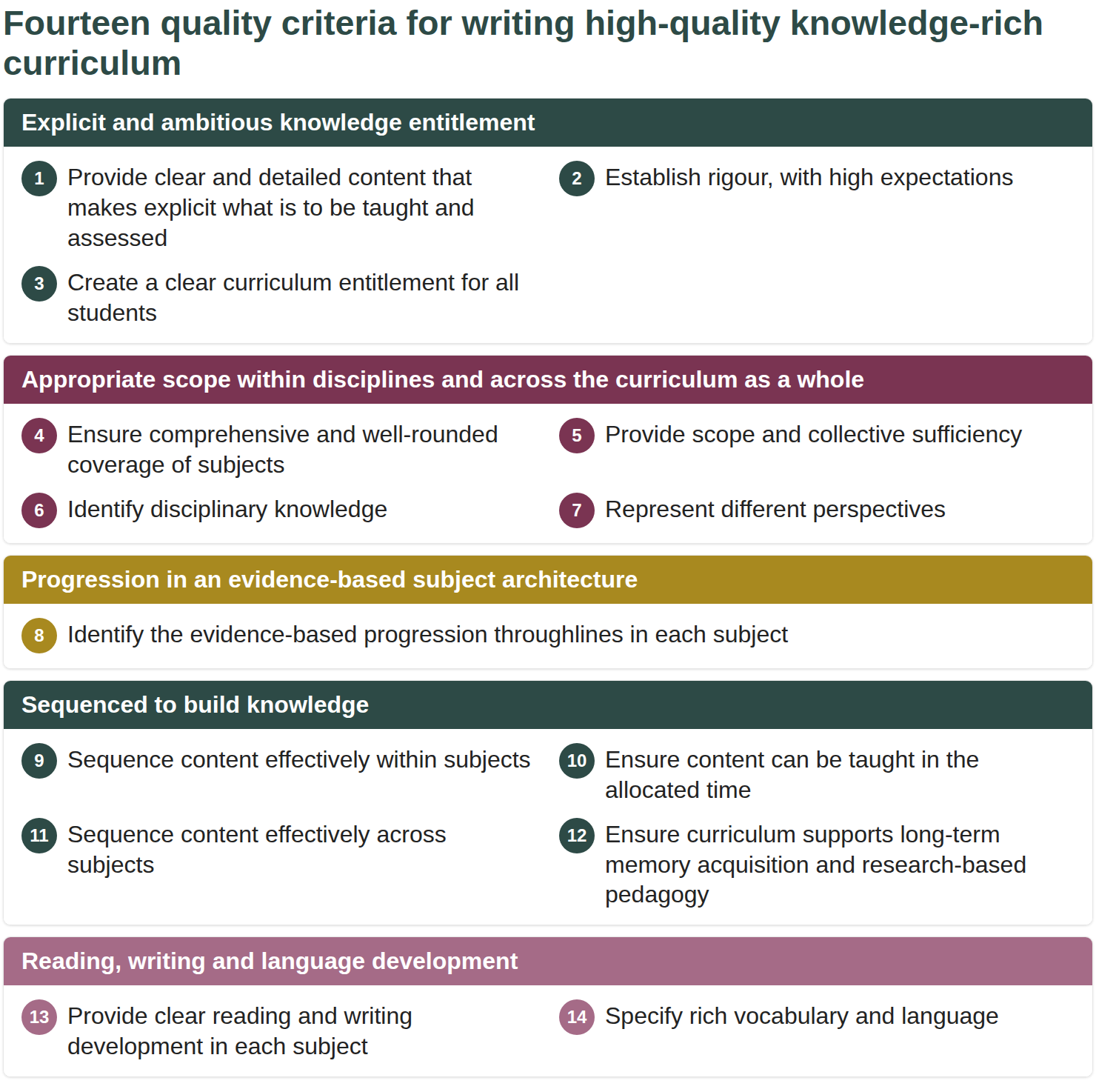
This report discusses each of these areas in detail, and identifies 14 quality criteria to support writing of a high-quality knowledge-rich curriculum. Each criterion is explained in detail and followed by discussion of potential pitfalls, along with checks to support curriculum writers and illustrated with examples from different countries.
The report is divided into three parts. Part One sets out the research on knowledge-rich curriculum, and provides evidence of its impact in schools and systems.
Part Two provides detailed guidance for curriculum writers that will also support broader curriculum reform work and debate on quality curriculum. Using the research and evidence discussed in Part One, we identify and discuss 14 quality criteria for a high-quality, knowledge-rich curriculum. We discuss pitfalls for curriculum writers to avoid and checks to ensure each criterion has been addressed.
The 14 criteria are organised under five areas: explicit and ambitious knowledge entitlement; appropriate scope within disciplines and across the curriculum as a whole; progression in an evidence-based subject architecture; sequenced to build knowledge; and reading, writing and language development. We summarise the 14 criteria in each of the five areas below.
Explicit and ambitious knowledge entitlement
1. Provide clear and detailed content that makes explicit what is to be taught and assessed
2. Establish rigour, with high expectations
3. Create a clear curriculum entitlement for all students.
High-quality curriculum needs to provide students with an explicit ambitious knowledge entitlement. Criterion 1 Provide clear and detailed content that makes explicit what is to be taught and assessed establishes that a high-quality knowledge-rich curriculum sets the content to be taught, its sequencing, and learning expectations. This works only if that content is stated clearly. Without clarity on content and standards, expectations slip and assessment is undermined, and much of the broader curriculum ecosystem, including how resources are created and curated, is compromised.
Ensuring clarity is not the first step for curriculum writers, but this criterion sets the scene for the work to follow. Clarity means stating explicitly what content is (and, to varying degrees, what is not) to be taught and assessed. The removal of significant ambiguity ensures there is less variation in implementation within and across schools, because school leaders and teachers know exactly what to teach.
A clearly specified curriculum at each year level supports building content sequentially over time, so that teachers know what students must master at each stage to be ready for what comes next. Such clarity also helps to ensure that content reaches all students. Too much school-level interpretation, by contrast, can result in different students being taught different content and being held to different standards.
Criterion 2 Establish rigour, with high expectations identifies that a high-quality knowledge-rich curriculum is rigorous: it sets ambitious expectations for what students learn and how that learning deepens at each year level, and it emphasises acquiring knowledge within subjects. Achieving this criterion requires establishing the critical content within each subject and setting expectations for learning that content at every year level.
Critically, when content is left out, or is not clearly specified as part of every student's curriculum entitlement, research shows that disadvantaged students are the most likely to miss out.[1] When they fail to specify content, curriculum writers are essentially saying they are comfortable with disadvantaged students not learning that content. Instead, Criterion 3 Create a clear curriculum entitlement for all students establishes that all students must receive a clear curriculum entitlement that has high expectations.
Appropriate scope within disciplines and across the curriculum as a whole
4. Ensure comprehensive and well-rounded coverage of subjects
5. Provide scope and collective sufficiency
6. Identify disciplinary knowledge
7. Represent different perspectives.
Criterion 4 Ensure comprehensive and well-rounded coverage of subjects establishes that a knowledge-rich curriculum needs to be comprehensive and well-rounded at both the system and school level. This requires covering the full range of subjects, with substance in each. For understanding the world in which they live and for reading comprehension, students need to study sciences, social studies, and the arts. Also, as Professor David Steiner of Johns Hopkins University notes, “these subjects are inherently interesting. They bring wonder and excitement to the classroom, making them necessary to inspire a love of learning."
Knowledge-rich curriculums are sometimes criticised as narrowly fact-focused. This misunderstands what a subject discipline is. A discipline is not a store of facts about a portion of the world but rather a distinctive way of organising what is known, and of establishing what counts as knowing it. This is a key reason why the range of subjects offered to students matters and why each must be given real substance.
Criterion 5 Provide scope and collective sufficiency emphasises that the curriculum in each subject should be broad enough in scope to include all the content students need to meet ambitious educational goals while giving students meaningful coverage of the subject. A curriculum is “collectively sufficient” when that selection of content, taken as a whole, gives students an adequate and coherent picture of the subject's field. The scope should be broad enough to form a genuine framework and detailed enough for that knowledge to be durable and usable.
It is useful to distinguish between hierarchical and cumulative subjects (these are defined in the Key Terms section). In hierarchical subjects such as mathematics, much of the scope of the curriculum is determined by identifying the subject throughlines and getting content within them sequenced correctly. In cumulative subjects such as geography, history, literature and religious studies, a curriculum writer can rely on no such logic. In cumulative subjects, unlike hierarchical subjects, the content, historical periods, geographical regions, and literary texts can appear interchangeable, because no single piece is individually necessary. This is why different topic choices are possible, and why the test of curriculum quality is whether the overall scope is collectively sufficient.
Criterion 6 Identify disciplinary knowledge discusses disciplinary knowledge. In some subjects, curriculum design involves two different kinds of decision. The first is what students need to know about the subject's content, the concepts, specific knowledge and facts that make it up, which is called substantive knowledge. The second is what students need to learn about how that content is established and tested within the discipline, which is called disciplinary knowledge. Two further terms appear alongside substantive and disciplinary knowledge in curriculum discussion and are easily confused with them. Disciplinary concepts are the lenses through which a subject asks its characteristic questions, such as cause in science, where scientists ask what produces an observed effect. Disciplinary practices are what specialists do to answer those questions, such as weighing evidence or constructing interpretations.
This substantive/disciplinary distinction is useful in subjects derived from academic disciplines whose practices can be meaningfully introduced at school level. It should not become a set of fixed headings imposed on every subject. In mathematics, for example, the characteristic practices of proof, abstraction and theorem construction are not activities that schools can realistically approximate. Similarly, in subjects organised around professional or practical aims, such as design and technology, the substantive/disciplinary framework is less useful.
In subjects where the distinction does apply, disciplinary knowledge should not be equated with things students do. This is firstly because much that could be classed as disciplinary knowledge is not procedural. Students need to know that a fair test changes only one thing at a time and they can be taught this through explicit instruction. It should also not be assumed that students learn about science better through practical activity. As Kirschner argues, expert practices are the endpoint of long knowledge accumulation rather than the means of acquiring it.
Criterion 7 Represent different perspectives emphasises that a high-quality curriculum is genuinely representative. A curriculum that consistently presents one cultural perspective as the default, or omits the knowledge, experience and contributions of particular communities, does not give students a full picture of the world. A high-quality curriculum is genuinely representative and explanatory, offering students both a window onto the broader world and a mirror of their own background and community. Students should encounter a broad range of cultures, groups and viewpoints across the full curriculum. This criterion does not need to apply to every lesson. Rather, curriculum writers need to identify where different perspectives and groups can be meaningfully included, so that they make a genuine contribution to learning within the subject. Importantly, a curriculum that is representative of different perspectives must ensure that content about under-represented groups is specified with the same disciplinary rigour applied to the rest of the curriculum. Tokenistic inclusions can do more harm than good.
Progression in an evidence-based subject architecture
8. Identify the evidence-based progression throughlines in each subject.
In a knowledge-rich curriculum, expectations of progression in student learning are articulated in progression throughlines that sequence knowledge accumulation that builds mastery in that subject.
One of, if not the main difference between a knowledge-rich curriculum and a skills or competency-based curriculum is how progression in student learning is portrayed. For example, curriculum reform in Wales and Scotland deliberately moved away from progression of learning within subjects. The Australian Curriculum followed the same pattern, de-emphasising progression in subjects and instead presenting learning progression in skills and competencies. In all systems, learning fell – often dramatically. In Portugal gains in learning were achieved across the country when the curriculum shifted to portray learning progression as knowledge accumulation towards mastery within subjects (see Chapter two for a more detailed discussion).
Criterion 8: Identify the evidence-based progression throughlines in each subject – therefore requires a fundamental decision; by identifying the progression throughlines in each subject curriculum writers are choosing to focus on the knowledge build within each subject. This paves the way for the detailed sequencing of knowledge along these progression throughlines which is explained in subsequent quality criteria.
Every subject curriculum repeatedly returns to certain bodies of knowledge, deepening student understanding with each encounter. In mathematics, number is one such body, sitting alongside others such as geometry and measurement. This report calls these persistent bodies of knowledge the subject’s progression throughlines – the lines along which expertise can grow over time. The major bodies of knowledge that organise a subject are called a subject’s architecture.
A knowledge-rich curriculum identifies the forms of knowledge that must be built to enable students to reach the expertise the subject is aiming for. Fordham's powerful observation that the curriculum itself is the progression model overturns the more common assessment-driven definition of progression as an escalating scale of performance or skill. Progression does not need to be layered on top of a curriculum; it already exists within one, as long as that curriculum builds towards subject expertise. Understood this way, the curriculum becomes the map of what knowledge accumulates, and assessment simply samples that accumulation rather than charting its own separate path.
Subject throughlines are not necessarily rigid. Subjects vary in how their knowledge accumulates. Hierarchical subjects such as mathematics, languages, phonics and grammar tend to require new content to rest on secure prior knowledge. Therefore, concepts must be taught in a set order. By contrast, cumulative subjects such as geography, history, literature and religious studies build knowledge of different topics over time without demanding a fixed topic sequence. Each new encounter with the concepts and ideas contained in a topic adds further depth, nuance and context to a widening schema or web of understanding.
Sequenced to build knowledge
Once a subject’s progression throughlines have been established, curriculum writers can focus on identifying the content of the curriculum and ensuring that it is properly sequenced, with clear progression in content. The four criteria relevant to this work are:
9. Sequence content effectively within subjects
10. Ensure content can be taught in the allocated time.
11. Sequence content effectively across subjects
12. Ensure curriculum supports long-term memory acquisition and research-based pedagogy.
Criterion 9 Sequence content effectively within subjects builds on the prior identification of the subject’s architecture. Once evidence-based progression throughlines have been identified the content of the curriculum can be identified and sequenced. Identifying progression in an evidence-based subject architecture and choosing and sequencing content are different tasks
Identifying progression in an evidence-based subject architecture requires identifying the progression throughlines along which understanding deepens over time in a subject. In mathematics these include number, geometry and measurement. In geography they include locational knowledge, place knowledge and knowledge of human and physical processes.
Once the progression in the subject architecture is identified, decisions on choosing and sequencing content can be made. Sequencing requires identifying knowledge components small enough to be taught and learned and the order in which they should be taught.
A curriculum can be sequenced with real care and still be built on the wrong architecture. The reverse failure is also possible. Both problems are avoided by treating these as two distinct decisions, taken in order.
Cognitive science research shows that we can learn only by making sense of new content using what we already know. A knowledge-rich curriculum clearly specifies the detail of knowledge, which is connected and sequenced so that learners’ mental schemas grow and broaden towards expertise, allowing them to understand increasingly complex material over time.
A knowledge-rich curriculum breaks down knowledge into what are termed here as components and composites. Components are the specific, teachable pieces of knowledge that students need to acquire in order to master more complex curriculum goals. Composites are more complex pieces of knowledge or understanding built from their components. Breaking knowledge into smaller components allows for a well-scaffolded curriculum sequence.
A well-sequenced curriculum requires writers to identify the specific component knowledge that each lesson or unit must establish. They must also ensure that this knowledge is in place before the learning that depends on it is attempted.
It is important to not strictly categorise a piece of knowledge as a component or a composite. They are relational terms, and the same knowledge can be a composite at one stage and a component at the next. Therefore, categorisation depends on the progression in the curriculum.
Sequencing should ensure that components are in place before the composites that require them are taught or attempted. In some domains such as mathematics, components must be known at the level of automaticity – the ability to perform tasks or mental processes without conscious thought or attention – because accurate-but-slow command of a component is insufficient. Automaticity in any prerequisite operations prevents cognitive overload when students learn or practise composites. Breaking knowledge into these smaller parts supports learning across the curriculum, as illustrated below.
Criterion 10 Ensure content can be taught in the allocated time addresses a step that curriculum writers often overlook, despite its importance. It calls for teaching programs to be drafted and tested against the instructional time schools have, in order to confirm that the content can be delivered within it. Much curriculum debate in many countries focuses on claims that the curriculum either can or cannot be taught in the allocated time. Remarkably, these debates often do not include data and evidence that test these claims. Curriculum reformers need to lead this debate and ensure the written curriculum can be taught in the time allocated in schools. This evidence not only guides curriculum writing but can be used to inform debate, and support effective implementation.
Criterion 11 Sequence content effectively across subjects establishes how content is coordinated horizontally and diagonally across subjects. Where these cross-subject connections are managed well, knowledge built in one subject can support learning in another. Where they are not, students end up being asked to draw on knowledge in one subject before they have developed it elsewhere, or are unintentionally taught the same content more than once across different subjects, wasting valuable teaching time. Deliberate planning across subjects cuts down on these gaps and duplication.
A teacher's grasp of the knowledge needed to be built step by step is essential to students’ making progress. If a knowledge-rich curriculum is to have any impact, students must master the content it intends them to learn. Criterion 12 Ensure curriculum supports long-term memory acquisition and research-based pedagogy ensures that crucial knowledge is secured before students move on. This can only occur when the curriculum is explicit about what students are meant to learn.
Reading, writing and language development
The final two criteria focus on writing a curriculum with clear reading and writing requirements for students. They are:
13. Provide clear reading and writing development in each subject
14. Specify rich vocabulary and language
Criterion 13 Provide clear reading and writing development in each subject establishes that students access and build knowledge through reading and writing. Typically, English (or similar subject in non-English speaking countries) is the only subject that takes explicit responsibility for students becoming fluent readers and writers, yet the whole curriculum depends on their developing those skills.
The relationship between knowledge and literacy runs both ways. Knowledge supports reading: how much a student already knows about a text's subject matter is one of the strongest predictors of whether they will comprehend it.Knowledge supports writing in the same way: understanding the structure of good writing is not enough on its own, since a student cannot build a causal argument or a considered judgement of significance without a firm grasp of the substantive knowledge that argument depends on.
The reverse is also true. Reading builds knowledge: encountering increasingly demanding texts and new content within a subject strengthens the schemas that make further reading possible. Writing also builds knowledge: having to produce extended prose forces students to organise, qualify and test what they know against the evidence, which consolidates their understanding and reveals where it falls short.
Writing is not transcribed speech. It is a different language, with different syntactic structures, discourse markers, and ways of organising thought. Writing enables complex, qualified, analytical reasoning to be organised and expressed. Therefore, writing must be explicitly taught.Curriculum design needs to build in appropriate opportunities for reading and writing.
Criterion 14 Specify rich vocabulary and language establishes that a knowledge-rich curriculum identifies the specific vocabulary worth teaching explicitly and works deliberately to build it. Both steps require intentional curriculum decisions. Vocabulary instruction matters most for students from less advantaged backgrounds, since vocabulary knowledge reliably predicts academic performance years later, and the gap between students with strong and weak vocabularies grows over time.[17] Most of the rare academic vocabulary students need appears in print rather than speech, so students with larger vocabularies find reading easier, read more, and extend their advantage further, while students with smaller vocabularies find reading harder, read less, and fall further behind. Even skilled teacher explanation draws on a narrower, more repetitive vocabulary than does written text.[18]
Part Three: Establishing and implementing an effective reform agenda
Part Three focuses on the curriculum reform process. Curriculum reform is hard, complex and usually contentious. We can never make it easy, but steps can be taken in the design and implementation of reform to make it productive. In addition, curriculum writing has to be supported throughout. Chapter ten and Chapter eleven provide steps for how this can be done and highlight differences in approach and design of reforms that may be needed in some systems.
Debate surrounding curriculum reform can be loud and challenging for system and reform leaders. It is difficult to lead curriculum debate that is often contentious. But in trying to avoid negative headlines, curriculum reform leaders can focus too much on how to respond to negative feedback rather than taking steps to set a proactive reform debate and agenda. Leaders need structures and support to do this work, and data from schools to support the case for change.
It is remarkable how often curriculum debate is very high-level, filled with broad sweeping generalisations that are often ideologically driven, and almost devoid of detailed analysis of curriculum documentation or what is actually being taught in schools. Such debates are often won by the loudest voices, not those with data and evidence of what is best to improve the curriculum taught and assessed in schools.
Curriculum reform leaders can elevate their message and set an effective reform narrative by focusing on what is happening in schools and classrooms and what is supported by the evidence (further discussed in Chapter ten).
It is vital to set a proactive reform agenda based on research, international best-practice, and perhaps most importantly, on the steps required to improve the curriculum taught and assessed in schools. Learning First’s work supporting curriculum reform in various systems has highlighted the following essential steps for building a proactive effective reform agenda and curriculum development process.
First, education leaders need to ground reform in data on the curriculum taught and assessed in schools: At its most fundamental level, effective curriculum reform articulates a pathway from current to future practice in what is taught and assessed in schools and classrooms. Data are needed to identify the starting point for what is taught and assessed in schools and then to monitor changes over time.
Grounding reform in curriculum implementation data in schools has three objectives:
· Grounding curriculum reform and debate in tangible improvements in the curriculum taught and assessed in schools and classrooms
· Clearly articulating the starting point for reform to shape curriculum writing and implementation and enabling a pathway to be built from that starting point
· Enabling monitoring and evaluation over time.
Curriculum implementation data are therefore needed to identify the starting point for reform - what is taught and assessed in schools at the start of the reform journey - and then to monitor changes over time. Such data would identify the strengths and weaknesses of current practice and how decisions are made and actions taken on what to teach and assess. A focus on this data pushes curriculum reform to the detail of the curriculum being taught in classrooms and the challenges school leaders and teachers face.
Second, education leaders should develop clarity on quality curriculum: It is imperative that systems create clarity on what constitutes quality curriculum. This needs to be more than a statement on the general direction of reform. It requires a discussion that identifies the research and sets parameters around what is and is not considered a quality curriculum.
Third, education leaders should establish effective leaders and experts to lead reform and write the curriculum: Strong and effective leadership is vital for change, especially when it comes to the highly challenging task of curriculum reform. The technical complexity of reform and the need for careful management of many stakeholders make it essential to be clear about who will assume leadership roles and responsibilities, and how leadership will be cultivated before and during the reform process. Two broad areas of expertise are needed: experts in knowledge-rich curriculum and curriculum subject experts. Leaders need a deep understanding of curriculum implementation, instruction and other work in schools. Finding sufficient expertise can be a challenge when a system is pursuing major reform, yet if gaps in expertise are identified, then they must be filled.
Fourth, Coordination and quality assurance of curriculum writing is another important step. An effective curriculum writing process needs to exist and this requires a coordinating function that sits above individual subject teams. The coordinating function checks consistency of structure and principle across teams, catches duplication and overlap between subjects, and monitors overload across the curriculum as a whole rather than subject by subject. Such coordination works when those providing it have enough command of the technical detail of the curriculum design and its broad implications for each subject.
An approach to implementation
In the end, the success of curriculum reform depends on what is taught and assessed in schools. An effective implementation approach focuses continually on the decisions and actions schools take over what they teach and assess in classrooms. The entire success of curriculum reform depends on it.
Such an approach requires a three-step process that identifies and monitors:
1. What is being taught and assessed in schools and classrooms
2. What are the decisions and actions taken by school leaders and teachers that determine what is being taught and assessed in their school and classrooms
3. Which policies and system interventions most impact the (curriculum) decisions and actions taken by school leaders and teachers.
These three steps need to anchor decisions about the design of policies and initiatives in how they impact curriculum decisions and actions in schools.
We need to be honest that it is unfortunately not uncommon for many teachers and school leaders to have a negative reaction to curriculum reform; it means more work for them, additions to an already hectic schedule, and attending professional learning and other initiatives that can vary in quality. Curriculum reform becomes not an improvement to their work life but something that happens to them. Effective implementation turns these feelings around. It enables teachers to see how a set of reforms improves what they do each day. But for reform to succeed, policies and initiatives that explicitly address these everyday challenges and concerns must be developed.
Every reform that doesn’t address the needs of teachers and school leaders not only wastes resources but increases frustration across the sector. Teachers wonder why the system is doing so much work but not what is most important to improve their school.
For example, our curriculum implementation data show that in many schools, teachers say they have access to lots of curriculum resources but don’t know which ones are best. A system that simply produces more and more curriculum resources is expensive and adds to teachers’ problems rather than solves them.
When teachers say their largest problems are understanding how to develop assessment tasks (and accurate assessment of student work across the school) that reflect curriculum standards and high expectations in each year level, then professional development setting out changes to curriculum documents becomes one more thing that clogs up their day.
When teachers say curriculum improvements are held up by requirements around school improvement planning and reporting, then it doesn’t matter how good system communications are – they are not addressing teachers’ main concerns unless planning and reporting requirements are changed.
On the other hand, when system leaders address and solve the problems teachers face then the narrative is completely flipped. Implementation is effective when teachers and school leaders can see themselves in the reforms; when initiatives solve the problems they face each day. Ensuring this occurs requires the development of system policies and initiatives with a focus on the decisions and actions of school leaders that have the greatest impact on the quality of what is taught and assessed in classrooms.
In some systems, initiatives to improve curriculum implementation focus on some professional development and perhaps curriculum resources. A focus on resourcing and capability building is obviously important, and should always be in the policy mix to improve curriculum implementation. However, relying on these initiatives is regularly too narrow and ineffective to result in widespread change. A broader approach is needed that concentrates on curriculum decisions and actions in schools.
The figure above (see report download) presents a framework for an approach to implementation that concentrates on school and classroom-level curriculum decisions and actions, and in doing so, broadens the policy areas and initiatives normally under consideration in curriculum implementation discussions.
The figure highlights the focus on what is actually taught and assessed in schools and classrooms. That is our strategic objective for curriculum reform so it should be closely monitored not only throughout the entire curriculum reform process but in ongoing data collections for schools and school systems.
One step back in the figure are teacher and school leader curriculum decisions and actions that determine what is taught and assessed in classrooms. Curriculum decisions and actions are influenced by what happens in a school and a system. Understanding these influences is crucial.
The left-hand side of the figure highlights the areas that most commonly impact teacher and school leader curriculum decisions and actions. It is not an exhaustive list but highlights areas most amenable to reform and that significantly impact curriculum implementation. A key determinant of curriculum decisions and actions in schools is the beliefs and understanding of quality curriculum of teachers and school leaders. Everyone knows this to be true, but beliefs and understanding are often not an explicit component of curriculum implementation planning. Such an approach highlights the impact of role models and leaders across the system. This also links to the development of career pathways in schools – and school systems – that recognise (and therefore encourage the development of) curriculum expertise. Effective implementation requires planning for short, medium and long-term increases in curriculum expertise – especially subject expertise – across schools and school systems. While this requires extensive capability development, creating structures and career pathways linked to the development of curriculum expertise assists curriculum implementation and reflects practice in high-performing systems around the world.
Other initiatives and areas that impact curriculum decisions and actions in schools include:
· Assessments, including standardised and high-stakes assessments and others
· Improving curriculum resources used in schools
· Curriculum implementation policy and advice
· Capability building
· Curriculum requirements, specifically regarding timing, subject requirements, and planning
· Monitoring and evaluation of curriculum implementation in schools and options for accountability linked to evaluation.
Assessment: System assessment structures and policies have perhaps the strongest impact on school leaders and teachers’ curriculum implementation decisions and actions. Assessments send powerful signals of what content should be prioritised and the standards expected of students. In doing so, assessments not only impact curriculum implementation decisions and actions, they can also build understanding of curriculum content and the expected standard of student attainment at relevant year levels.
But this influence cuts both ways. Assessments that reflect the curriculum reinforce it; those that do not can push teachers away from teaching the curriculum as intended. Standardised assessments can have a positive or a negative impact depending on how they influence teachers’ decisions on how to teach the curriculum. Many common literacy assessments, for example, have been shown to push teachers away from the curriculum, and towards resources and programs that teach generic skills that don’t improve reading.
In England, for example, after national primary science testing for 11-year-olds was scrapped in 2009, published sampling data and inspection findings showed a swift and substantial drop in both science teaching time and attainment, a decline plausibly linked to the removal of that testing lever. By contrast, England’s introduction of the phonics screening check in 2012 coincided with a sustained climb in its international reading rankings and clear gains in phonics teaching, while the multiplication tables check, made statutory in 2022, has seen average scores rise every year since then. Both tests assess genuine components of learning rather than proxies for it, which may explain why they have been able to support students' progress.
Monitoring and evaluation: Since reform seeks to improve the curriculum taught and assessed in classrooms, this is what should be monitored and evaluated over time. Monitoring and evaluation mechanisms send a message to schools on what to prioritise for improvement. They provide teachers and school leaders with reinforcement mechanisms as they change their practice, which is crucial for individual and organisational change. They also enable information about what is and is not working in schools to be shared across a system to inform improvement initiatives.
Capability building with curriculum reform: Curriculum reform should distinguish between the immediate or short-term needs of teachers and school leaders and a longer-term capability building strategy. In the immediate term, two areas of focus dominate professional development:
· Understanding the new curriculum, especially key content changes and how to read new curriculum documentation
· Understanding quality curriculum and the rationale behind reforms.
A longer-term capability building strategy should centre on lifting curriculum expertise, particularly subject-specific curriculum expertise, across schools and the system. This approach aligns with the establishment of a knowledge-rich curriculum grounded in the teaching of subjects, and reflects standard practice in high-performing systems.
Building curriculum subject expertise raises the question of which subject content to prioritise, and what professional development and training should focus on to build that expertise. Capability development needs to focus on the specific content set out in the curriculum, not on broader subject knowledge. For example, teacher training and professional development should be built around the science curriculum itself, rather than science as a general field of study.
This report uses the term curriculum journey knowledge to describe a teacher's understanding of how subject content is structured and sequenced over time: what is to be learned, in what order, and when, in order to support subject progression over the long term. Curriculum journey knowledge is not the same as a teacher's choices about how to communicate knowledge in the moment of teaching or as the moral or cultural purposes of education. It refers instead to knowledge of the subject curriculum's internal logic (such as subject architecture, progression throughlines and the building blocks of component knowledge) as a journey towards expertise.
Improving curriculum resources used in schools: School leader and teacher choices on which curriculum resources to use can significantly determine the success of implementation. Resources need to embed changes made to a national or system curriculum, and to be high-quality, reflecting the research on what improves student learning and equity.
Systems can seek to improve the quality of curriculum resources used in schools in three main ways. They can develop resources for use in schools (direct provision). They can influence how schools choose curriculum resources, and they can influence the market for curriculum resources.
Curriculum improvement as an ongoing process
High-performing systems have structures in place to ensure that curriculum improvement is ongoing. They regard implementation, expertise-building and improvements to subject curriculums as vital aspects of continual system improvement. By contrast, some systems structure curriculum reform as an activity that occurs once every five to ten years, a huge and difficult process that – in crude terms – turns on and off once during that period. Many of the challenges discussed in this report, such as the need to build a common understanding of quality curriculum and to develop expertise in it, are better addressed as ongoing initiatives.
Singapore has a rolling curriculum review and improvement process, in which each subject is reviewed every six years. Such an approach helps curriculum reform leaders to embed reforms and support ongoing implementation efforts. Effective, coordinated curriculum reform should not only embed improved curricular practice in schools and classrooms, but also be structured to improve the next system curriculum reform.
Curriculum and curriculum resources
Curriculum is a highly contested term. While this report does not seek to argue for a new definition, it is important to be clear how the term is used here.
The system curriculum is the national, state or provincial curriculum: the statutory or official specification of what all students should be taught. The school curriculum is what a school specifies its own students will be taught. It is developed by translating the system curriculum into long-term and medium-term plans, unit sequences and teaching programs and so on. Schools make real curriculum decisions at this level, since the system curriculum cannot generally specify content at the granularity a teacher needs.
Curriculum resources are the materials through which the curriculum is taught: textbooks, programs, lesson plans, notes and slides.
In addition, this report uses the term knowledge-rich curriculum throughout, although not every country or system that has pursued this kind of reform uses the same label.
ChaptersPart One: Research foundations of a knowledge-rich curriculum
Research Foundations of a knowledge-rich curriculum
Impact of a knowledge-rich curriculum
Curriculum benchmarking
Part Two: Guidance for curriculum writers
Explicit and ambitious knowledge entitlement
Appropriate scope within disciplines and across the curriculum as a whole
Progression in an evidence-based subject architecture
Sequenced to build knowledge
Reading, writing and language development
Formatting curriculum documents
Establishing and implementing an effective reform agenda
Establishing an effective reform agenda
An approach to implementation