

When schools don’t have a high-quality, content rich curriculum, inequality increases
Federal Education Minister Jason Clare has made reducing education inequality a priority. In March the minister announced the creation of an expert panel chaired by Lisa O’Brien, “to inform a better and fairer education system”. The panel’s report, due by the end of October, will inform the next National Schools Reform Agreement, which will determine school funding and related policies. The minister has instructed the panel to focus on inequality and students who are most at risk of falling behind.
Clare has been clear and honest about the extent of the problem. Last year he pointed out that the inequality gap widened as children progressed through school. While the gap between year 3 students from high and low socio-economic backgrounds is equivalent to two years of schooling, “that gap grows with every year of school. By the time they get to year 9 that gap is five years.”
It is easy to be pessimistic about how much we can address education inequality. Australia’s education performance has declined, and inequality increased in international tests despite significant growth in expenditure, as the Productivity Commission recently highlighted. A long line of high-profile education ministers has failed, despite the best intentions, to shift the inequality needle.
But I am optimistic. While previous ministers faced school funding debacles coupled with policy options that were expensive and often unproven, emerging research shows that Clare has cost-effective reforms available to him right now that directly address the inequality growth he has highlighted. A growing field of curriculum research around the world shows when schools (and school systems) don’t have a high-quality, content-rich curriculum then inequality increases in exactly the pattern that has occurred in Australia. This research also shows when you make the shift to a high-quality, content-rich curriculum then you can close much of the inequality gap that for years has plagued Australian education.
To illustrate what can be done, we need to go through a series of steps that are not discussed often enough in Australian education policy circles. If inequality worsens the longer students are in Australian schools, as Clare has rightly stated, then to reverse it we need first to be clear on what we are actually measuring.
The federal government’s own consultation paper for the expert panel says “inequality is entrenched” in Australian education. NAPLAN data presented in the paper shows that between 2008 and last year the gap between poor and wealthy students in grade 3 reading grew from 1.4 to 2.2 years of learning. By the time students reach year 9, the gap is 5.1 years.
In other words, inequality worsens as students progress through school, and is getting worse across time. This is part of an overall decline in secondary school reading. In 2018, the reading performance of Australian 15-year olds in the OECD’s Program for International Student Assessment was around nine months behind the level of Australian students in 2003.
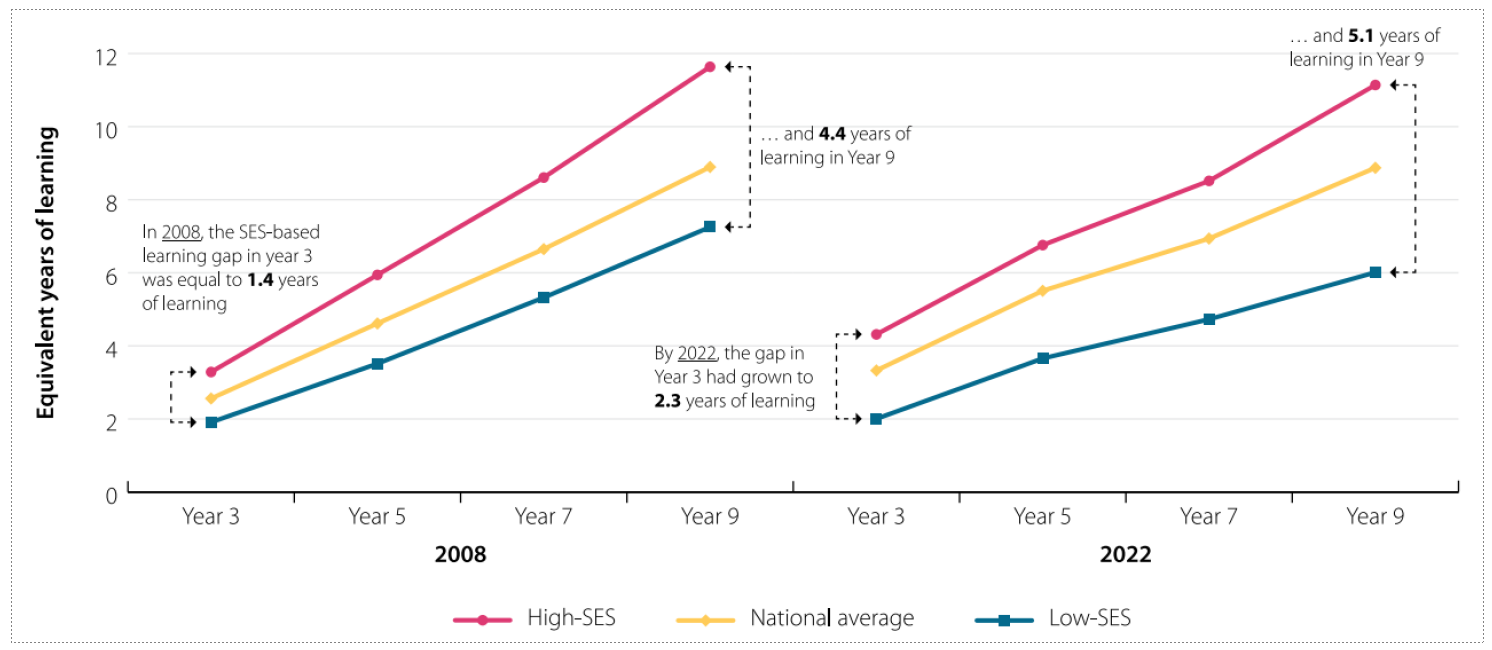
Achievement gaps in reading between high and low socio-economic status (SES) students
To understand how we got here, it is important to know that the way we assess students’ reading ability changes as they move through school. In the early primary years, the focus is on assessing how much students have grasped the fundamentals of how to read. But in later years the focus of reading tests change: students are assessed on their ability to comprehend increasingly complex passages in reading comprehension tests.
It follows, therefore, that what is required to improve reading scores in the early years of primary school is different from what is required in later primary and secondary school.
Reading tests in the early years assess the fundamentals – students’ ability to read. The research shows that the ability to decode words is the best predictor of high performance on these early reading tests.
Decoding and other aspects of learning to read form the basis of what has become known as the “science of reading”. The evidence on the science of reading is now overwhelming. As the Australian Education Research Organisation states, “the science of reading provides the strongest evidence about how young children learn to read”.
Reading is one of the most researched areas in education and we know a lot about effective practice in phonics, fluency, vocabulary and comprehension. These fields are all covered in the science of reading, but too often the public discourse focuses on phonics and core literacy skills, and much less on reading comprehension, particularly in secondary schools. Yet this is where inequality has greatly increased.
In assessments of reading comprehension, students are given text to read and asked questions that assess their understanding of it. A large determinant of how students perform on these tests is their background knowledge of the topic they are reading about. In brief, you will do better in understanding a passage in a reading test if you know something about the topic than if you don’t.
Many research studies through the years have shown that students’ background knowledge, in science, history, culture and other fields, determines reading comprehension more than whether students are good or poor readers.
In the most famous study, US students were asked to read a passage about baseball in a reading comprehension test. Researchers had previously tested them as good or poor readers; they also measured their background knowledge about baseball. The test results showed that students who had been considered poor readers but knew a lot about baseball outscored students who were tested as good readers but didn’t know much about the sport.
This finding also shows why providing different reading comprehension tests to the same group of students can lead to very different results. Students categorised as poor readers in one test can have entirely different results in another test with a different topic.
A key reason is that to comprehend a text we have to process both its explicit and implied information. Background knowledge helps us to make meaning from all the information, and to fill the gaps in what is implied or missing. It therefore reduces what education researchers call the cognitive load required to comprehend a text.
The good news is that Australia is moving in the right direction on how to teach students the fundamentals of how to read in the early years of primary school.
The success stories of systems and schools that have embraced the science of reading to teach students to read in the early years of primary schools is increasingly well-known.
It is terrible that some systems remain unclear on how to teach reading, and the students paying the highest price come heavily from disadvantaged backgrounds. Yet while Australian inequality in learning to read in the early years is still far too high, we are making progress.
However, when it comes to improving reading comprehension in the later years – the area where inequality is greatest – Australian systems are too often ignoring the evidence. The research shows that to improve reading comprehension we have to improve students’ background knowledge.
But students are by no means all at the same level. Those from wealthier families typically have higher levels of background knowledge about different topics than poorer students do. They generally come to school with more knowledge about the world, and during the course of their schooling the gap over students from lower socio-economic backgrounds grows significantly.
This finding – well known among researchers – explains why Natalie Wexler, a global leader in the field, refers to the inequality gap in reading comprehension in upper-primary school and secondary school as a “knowledge gap”.
To reduce the growth in inequality that Clare is highlighting, the knowledge gap between low and high socio-economic students must be bridged. The way to do this is through a content-rich curriculum that enables all students to have the learning experiences that enable them to bridge the knowledge gap.
Students get knowledge in school through the curriculum. A high-quality, content-rich curriculum builds deep knowledge in a clear and sequenced manner. It enables students to comprehend increasingly complex texts. In so doing, it can significantly reduce the impact of differences in socio-economic background. A low-quality curriculum, by contrast, prevents poorer students from building the knowledge that will enable them to bridge the inequality gap.
Sadly, the Australian curriculum could never be considered a content-rich curriculum. Compared with leading curriculums overseas, it is astonishingly light on detailed content and the sequence in which it needs to be taught. Important content is absent from the curriculum,
optional for teachers to teach or is discussed with such ambiguity that it can be interpreted in many ways.
Education systems with higher performance and less inequality have followed the research on content-rich curriculum. For example, Alberta, Canada performs much higher on international test and with less inequality than Australia. Its curriculum is explicit on the precise content to teach and when it needs to be taught. Whenever I show the Alberta curriculum to Australian teachers they are shocked by how much clearer and easier it would be to teach than the Australian curriculum.
Consider important content in the science curriculum such as the topic of body and plant systems, which the Australian curriculum introduces in year 8. The precise content and sequencing of that content are not made clear. The curriculum says students are expected to “analyse the relationship between structure and function at organ and body system levels”.
Teachers are left to decide which plant, animal or human systems to teach – should students be taught the human cardiovascular system in-depth, should they include the bovine digestive system or should students be taught a little bit of a wide range of plant, animal and human systems? These are complex questions that determine how students’ knowledge and understanding of the world builds in school.
Contrast this to Singapore’s curriculum that consistently produces some of the highest learning outcomes in the world. From primary school – years before it is made clear to teach in the Australian curriculum – Singapore’s science curriculum names which systems to teach in which organisms, and what content should and shouldn’t be covered at each grade level. This guarantees that all students receive the essential build of rich content to develop mastery of the topic. This follows every bit of research we have on how students learn.
In English (and across much of the humanities), the knowledge students gain is largely determined by the texts they read. The Australian Curriculum is largely silent on the texts students should read in English. Many parents are (rightly) shocked to learn that there is little curriculum guidance on the books that students should read, the sequence in which they should be read or the learning tasks students should complete after reading the book.
The research shows that to improve learning and bridge the inequality gap, all students need to be discussing and writing about complex texts daily to build knowledge in more equitable ways. Recent research in the US has highlighted how a high-quality curriculum can be introduced to education systems and bridge the inequality gap.
The Core Knowledge curriculum is one such example that provides rich content in English, science, history, geography, the arts and other subjects. The content is clear and tightly sequenced, so that knowledge builds on itself. It is impossible to read this curriculum and not be amazed by the breadth and depth of learning experiences available to all students. The differences with the Australian curriculum are stark.
A multi-year research study compared the outcomes of students in Colorado schools that used a high-quality, content-rich curriculum with those in schools that lacked such a curriculum.
All students in schools in the first group significantly increased their learning and reading comprehension. Most important for Australia, students from poor backgrounds had the greatest gains – gains so great that the inequality gap was largely erased. Unfortunately, this research is not discussed enough in Australian education policy circles.