

Curriculum

Improving the quality of curriculum at each level of a system is perhaps the most important reform that system and school leaders and teachers can make.
Our focus on curriculum reform began when our work with systems and schools to implement high-quality professional learning and training programs were continually falling down because of poor curriculum and curriculum implementation.
The research is clear that improving the quality of the curriculum taught and assessed in schools has one of the largest impacts on learning, and the impact is greatest for disadvantaged students meaning curriculum reform is one of the best ways to close the equity gap in many systems. But system curriculums, and their implementation in schools, need considerable improvement in many countries if we are to significantly improve learning and equity.
Our work with systems and schools is based on years of research. We have surveyed tens of thousands of teachers and school leaders on their curriculum planning and implementation decisions so schools and systems can design better supports and resources for schools. We have worked with leading systems around the world on how they undertake curriculum reform, and what does and doesn’t work when designing and writing a new curriculum. We have also published a number of research reports on quality curriculum and curriculum reform (see below) with more coming soon.
Systems
We support systems to improve their curriculum, providing the research and analysis needed, and the steps system leaders need to take to write a world-class curriculum.
We regularly collect data from schools to inform how to reform the system curriculum and improve implementation policies and supports.
Schools
We support schools to review and evaluate the strengths and weaknesses of their curriculum, improve curriculum planning and implementation, and build curriculum leadership capability.
Curriculum improvement can be a difficult change process, so we work closely with schools on the steps to take to bring everyone on a curriculum improvement.
Curriculum Benchmarking: Understanding the rigour and quality of a Curriculum
Detailed curriculum benchmarking is essential to develop a world-class curriculum. It is the detail of the content that matters as it is the detail that is taught and assessed in classrooms. It is this detail that sets the floor and ceiling of student learning.
Comparing curriculums is not new, but many reports lead to spurious findings as they are too high-level. High-level analysis has seen many curriculums categorised as similar when more rigorous benchmarking has shown that the content is quite different. This leads to missteps in curriculum design and writing.
We support systems to design and write high-quality curriculums by rigorously benchmarking content across subjects and year levels. Our approach enables systems to compare the depth and breadth of content to other systems, define clear proficiency expectations, and map coherent student progression. We identify content gaps, overlaps, and excessive jumps between year levels, strengthen the clarity of content descriptions so teachers know exactly what to teach and assess, and ensure the overall level of challenge drives deep, rigorous learning.
Benchmarking provides a clear evidence base to design and write a world-class curriculum. For example, it has shown how some curriculums can have more content but less progress for students as the depth and breadth of topics covered was misplaced, and the progression of learning was lacking.

Fixing the hole in Australian education report
2023
The Australian Science Curriculum Benchmarked Against the Best.
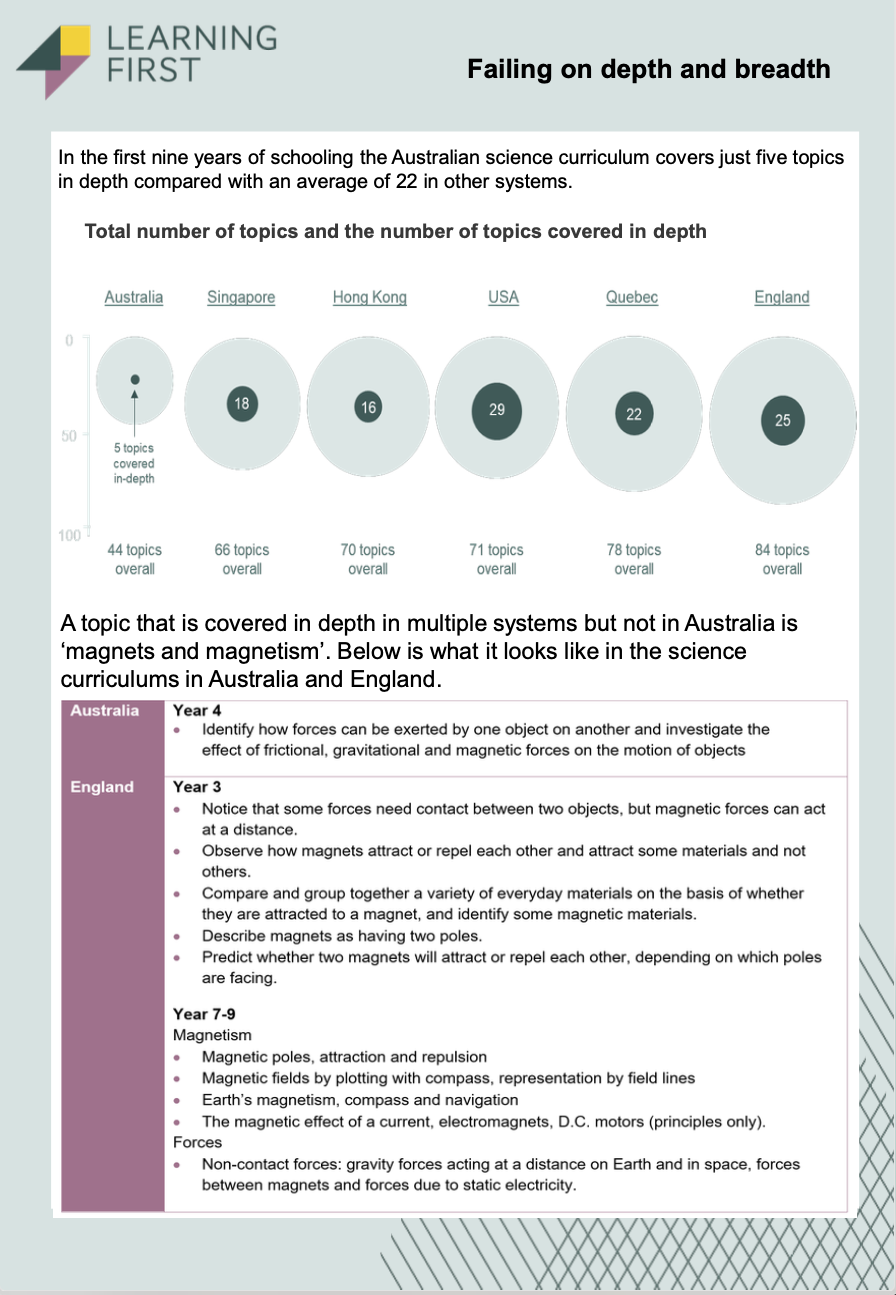
Infographic: Failing on breath and depth
2023
Benchmarking breadth and depth of Science curriculums.
Other related reports
What we teach matters
April 202
Report written in collaboration with Dr David Steiner, Executive Director of the Johns Hopkins Institute for Education Policy
Overcoming challenges facing contemporary curriculum
November 2018
Lessons from British Columbia.