

The experience of remote and flexible learning in Victoria
Published July 2020
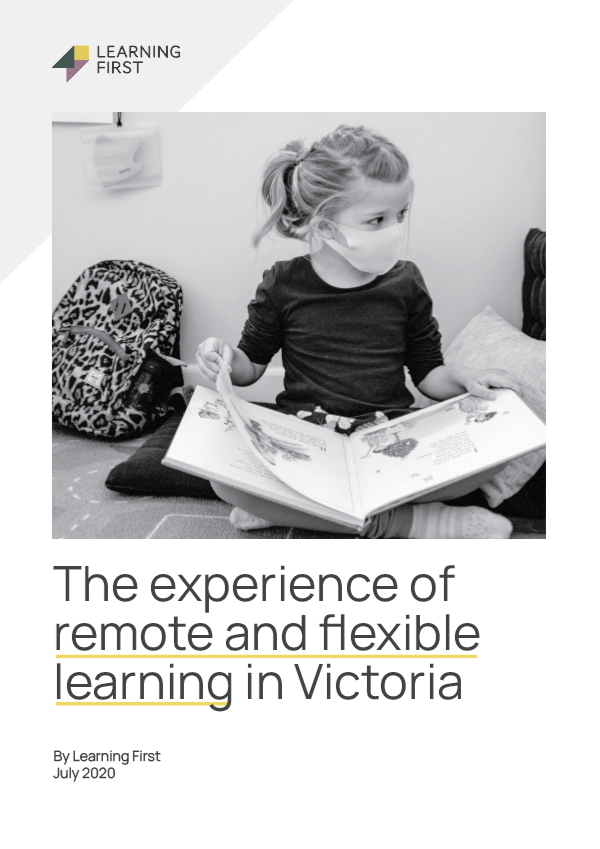
About this reportThis report, produced by Learning First in July 2020, examines how Victorian schools experienced the shift to remote and flexible learning during the COVID-19 pandemic.
It draws on a wide range of data collected between March and June 2020, including surveys of over 20,000 students and 12,000 parents across hundreds of schools, weekly check-ins with school leaders, 28 focus groups and workshops, and administrative data on student attendance and staff wellbeing.
The findings reflect a moment of significant challenge and adaptation, and are intended to help schools build on what worked while addressing the gaps and inequities the period exposed.
Executive summaryIn March 2020, the Victorian school system confronted one of the gravest challenges it had faced in many decades. With the onset of the COVID-19 pandemic, the State Government took decisions designed to save lives by reducing opportunities for human transmission of the Coronavirus. On March 16 it announced the closure of schools for most students. Almost overnight, schools were required to put whole curricula online, and establish new methods of teaching, learning and student support. The pressure on staff, students and parents was intense. No one could be sure of the way forward, since no one had previously endured such a crisis.
This report presents findings from surveys, focus groups and interviews conducted with school communities to understand their experience of the remote learning period, which ended for all students on 9 June. The report shows that school leaders, teachers, students and parents rallied to meet the challenge head on. School attendance rates remained high -- the vast majority of students took part in remote and flexible learning every day. Morale also stayed high, in the main, as teachers and school leaders worked together to address difficult dilemmas with a sense of mutual respect and common purpose. Parents gained unprecedented insight into their children’s education and school, bringing potential benefits for years to come. New skills have been acquired, new pedagogical opportunities trialled.
However, the period also exposed new challenges, especially for teaching and learning. Reduced face-toface contact with at-risk students made it difficult for teachers to address ongoing welfare or educational concerns. Some students who lacked supportive family environments struggled to access learning or even log on to classes. About 10 per cent of students from disadvantaged schools were absent during the remote learning period, compared to about 4 per cent of students from advantaged schools. Absenteeism of secondary school students rose in the final two weeks of remote and flexible learning, and many teachers reported slipping student engagement as the lockdown progressed, suggesting that some students struggled to stay the course. Schools face serious difficulties in reintegrating these students into learning and school life. There is a risk that the online learning period has widened the gap between high and low-performing students.
Students were divided in their experience of the remote and flexible learning period. Some greatly enjoyed the flexibility of learning from home, the chance to set their own hours and study regime. Some highly motivated and high achieving students especially thrived on the opportunity to work alone, at their own pace. A surprising outcome was that many students who are normally shy and quiet in class spoke up and contributed more in the online environment. On top of this, a number of teachers and school leaders reported that many students where more engaged with online learning. Nevertheless, more than one in eight students found it hard to maintain focus and not get distracted at home. Children in the early years of primary school, and from low literacy backgrounds in all years, were particularly challenged.
The shift to online learning was a dramatic change; many schools dropped specific subjects, tried to trim content within subjects, and reduced daily contact hours and student workload. Usual assessment techniques became extremely difficult. A number of schools found their assessments during remote and flexible learning to be invalid. Some schools did not focus on assessments during the period, and as schools entered the final week of Term 2, a Department survey found that between a quarter and a third of schools have yet to reach a conclusion about the academic progress of a majority of their students during the period of remote learning. Moreover, nearly one in five principals reported concern or strong concern, about the lack of academic progress during remote learning. These concerns were especially prominent in regional areas.
As schools return to normal, and the sense of purpose that is generated by a crisis passes, the Department and schools should keep an open mind about the gains and losses this period has produced. Online learning is a large and growing part of our educational future. Nevertheless, it is striking, and heartening, that many students missed aspects of school and were glad to return to it. Victoria’s schools should be proud of that, and of what they achieved during this difficult time.
ChaptersThe experience of four schools
Lessons learned for improving education
Attendance
Student experiences of remote and flexible learning
Parent experiences of remote and flexible learning
Teacher experiences of remote and flexible learning
School leader experiences of remote and flexible learning
Teaching and learning
Engagement of vulnerable, at-risk, and low-and high motivation students
School-family connections
References