

Australia’s primary challenge: how to lift teacher quality in early school years
By Dr Ben Jensen, Katie Roberts-Hull, Jacqueline Magee, and Leah Ginnivan
Published April 2017
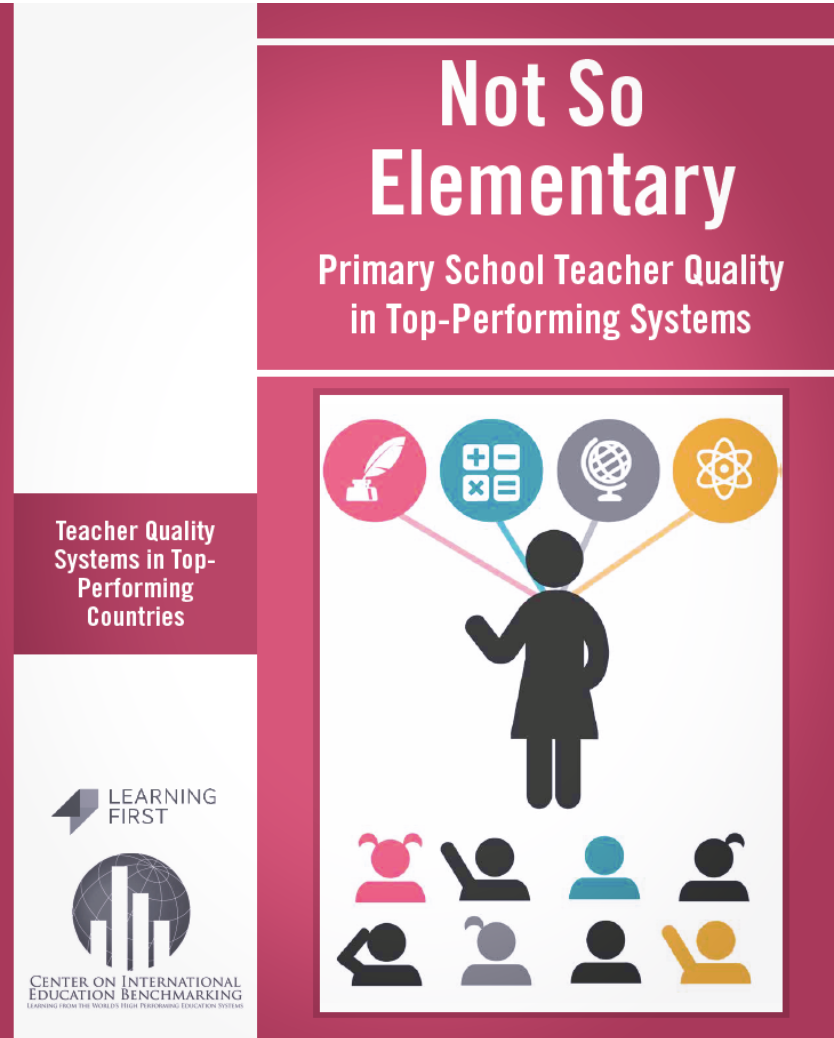
About this reportThis report is the Australian edition of the 2016 international study Not So Elementary, commissioned by the Center on International Education Benchmarking at the National Center on Education and the Economy. It draws on extensive research and interviews conducted across four of the world's highest-performing school systems - Finland, Japan, Hong Kong, and Shanghai - to examine how these systems develop and sustain strong subject expertise in primary school teachers.
The report addresses a pressing challenge for Australian education: despite a decade of stagnating student achievement on international assessments, opportunities for primary teachers to build deep subject knowledge remain scarce. By examining how high-performing systems approach teacher selection, specialisation, initial teacher education, and ongoing professional learning, this report offers practical policy insights for Australian policymakers, school leaders, and educators looking to strengthen teaching quality in the early school years. It aims not to prescribe a single solution, but to provide evidence-based lessons that Australian systems can adapt and evaluate within their own contexts.
Executive summaryAustralian students have not improved their achievement on international tests for a decade, and are falling behind students in many other advanced nations. In maths, the proportion of high performers in PISA has halved to 11 per cent over the past 14 years, and low performers outnumber high performers two to one.
As public alarm over these results has grown, discussions have focussed on the need to strengthen teacher skills to improve student learning. This report shows how four of the world’s highest-performing school systems -- Hong Kong, Japan, Finland, and Shanghai -- place a strong emphasis on teacher subject expertise, even in early year schooling. In these and other systems, the most effective teachers do not just know their subjects (content knowledge) they also how to teach them (pedagogical content knowledge). Acquiring both forms of knowledge is more important and more difficult than many people realise. Yet opportunities for Australian teachers to do so, particularly in primary teacher education and primary schools, are scarce.
Concerns that primary teachers have inadequate subject expertise have been well documented. Problems exist at every step along the teacher development pathway. In particular:
Because teacher education programs are unselective, the science, literacy, and maths expertise of prospective primary teachers is generally not strong.
Primary teacher education programs have few quality courses in each subject area. Students therefore spend minimal time developing teacher subject expertise. Assignments often lack rigour and the bar for course completion is low.
When prospective primary teachers apply for jobs, adequate subject expertise is often not important in the hiring process.
In the classroom, teachers often lack support, meaningful subject-specific
professional learning and high-quality instructional materials -- all of which help them to develop subject expertise.
There are many exceptions to this narrative but overall, the development of primary teacher knowledge in key subject areas is inadequate. In a downward spiral, teachers with low subject expertise teach students who learn less, who then become teachers with even less subject expertise. Acquiring on-the-job subject expertise is particularly difficult for primary teachers, who often teach five or more subjects.
Hong Kong, Japan, Finland and Shanghai are known for emphasising high standards in primary teacher subject expertise. This report shows how Australian systems can begin to apply similar policies to ensure that such expertise reaches our classrooms.
One thread that unites all four systems is that primary teachers specialise, enabling them to develop deep knowledge in just one or a few subjects. In Shanghai and Hong Kong, primary teachers teach fewer subjects. In Finland and Japan, they teach all subjects, but in training and development focus deeply on just a few. This specialisation allows the deep subject expertise development that is necessary for great teaching.
Success in these systems is driven not by one simple reform, but by many policies combining to reinforce and support teacher knowledge. Becoming a primary teacher requires meeting a high bar of subject-specific knowledge. Initial teacher education includes rigorous content in each subject. In-school professional learning is also subject-specific, allowing access to subject experts and quality instructional materials.
The quality of teaching and learning in primary school significantly affects later academic and life outcomes, as well as the economic health of the nation. Australia needs to get its approach right.
ChaptersPart I: Teacher subject expertise
Teacher subject expertise
What is known about mathematics, science, and literacy teacher knowledge?
Part II: Policies: Lessons from Japan, Finland, Shanghai, and Hong Kong
Selection
Specialisation
Initial teacher education: foundational subject preparation
Professional learning: Subject-specific support in schools
Implications for Australia
Conclusion: policy insights at a glance